
The Print Production Management process
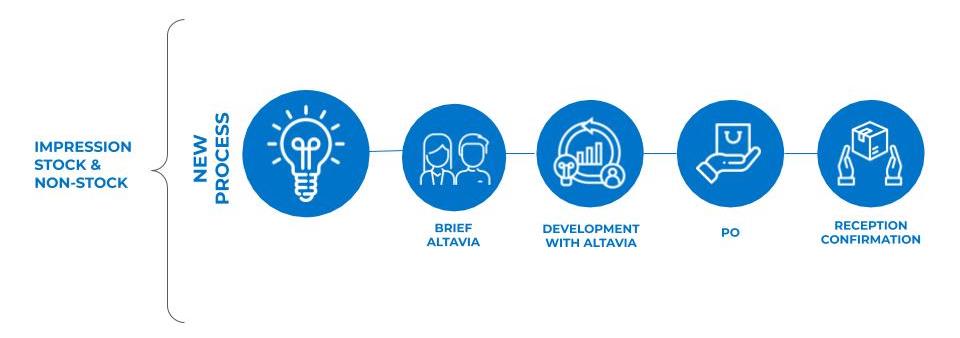
The process begins with sending the completed brief via BOL to Altavia-Prodity. L’Oréal then develops the project with Altavia, sends its PO and the product is printed and delivered.
The stock products are then delivered to BDL, or to subcontractors, such as KD and Harling. Non-stock products are delivered to the L’Oréal head office or directly to retailers.
The steps to realize a project
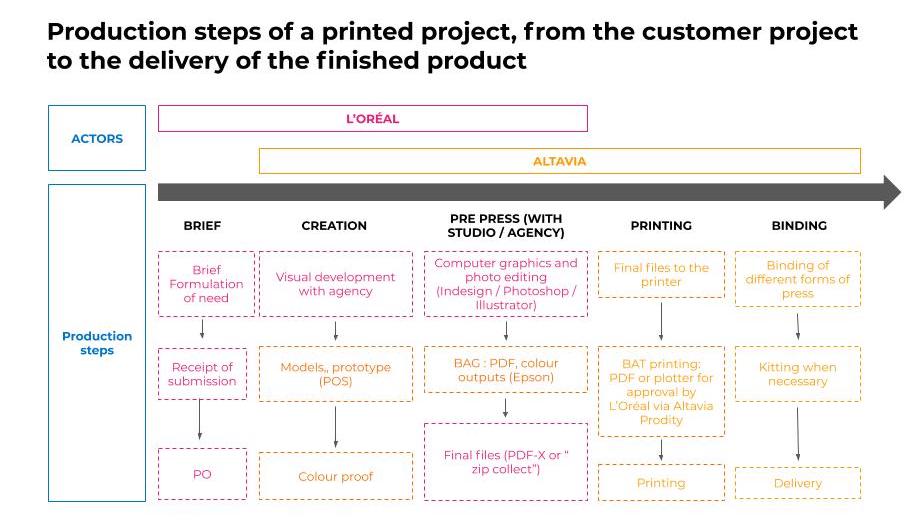
The brief: L’Oréal drafts the brief and sends it via BOL. Then, L’Oréal will receive the quote from Altavia. After approval, L’Oréal will send its PO.
Creative: L’Oréal will create the artwork and Altavia will support them by producing mockups and prototypes, if necessary.
Pre-press: L’Oréal produces the final files and sends them to Altavia.
Printing: Altavia delivers the files to the printer, and then sends the paper color proofs or PDF to L’Oréal. Once the proof is approved, the project is sent to print.
Binding: Once printed, the project is bound and goes through other finishing stages, if necessary. The product is packaged and kitted, if applicable. The product is then delivered.
The manufacturing process
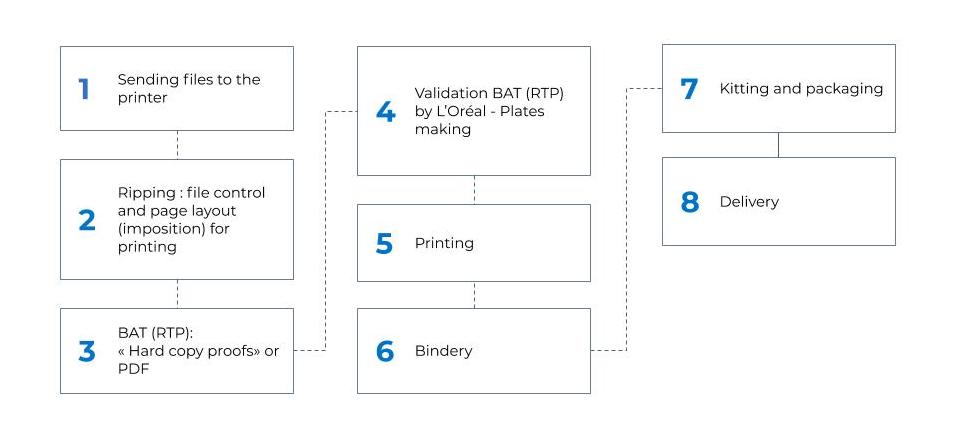
1. Delivering the files to the printer: Make sure to send your final files ready for production: high-definition files with all the artwork (fonts, images, photos ..) and make sure that your files also include crop marks and bleed.
2. Ripping: technical and quality control « preflight » which consists of verifying your files to validate that all the required elements are included (photos/images received in high resolution, dimensions, bleed, etc.). This is when the files are being produced as proofs for your approval.
3. Hard Copy profs: is a paper or PDF proof. Also called low resolution proof, this is the proof that confirms the shape of the printed project. It is important to remember that it represents the final dimension of your project as well as the positioning of artwork and copy. The colors are only there for reference. For an accurate color representation, you should refer to the Epson proof.
4. BAT validation by L’Oréal – Preparation of the printing plates: once the BAT is approved, we proceed to the fabrication of the printing plates that will be used for printing your project.
5. Printing: your project is now being printed on the type of press required (offset, digital, large format).
6. Binding: refers to all the activities that are performed on printed material after printing, according to the product (leaflet, leaflet, brochure, notepad, clipclap, cube box…).
7. Kitting and packaging: Packaging is one of the last steps that will dictate the quality and condition of your product at its final destination. Packaging can be put together in cello, Kraft package, in boxes and on pallets. It is therefore important to plan for this step as soon as the project is created.
8. Delivery: this last step must be clearly defined. It is important that the information is communicated correctly (address, contact, whether making an appointment required or not, etc.).
